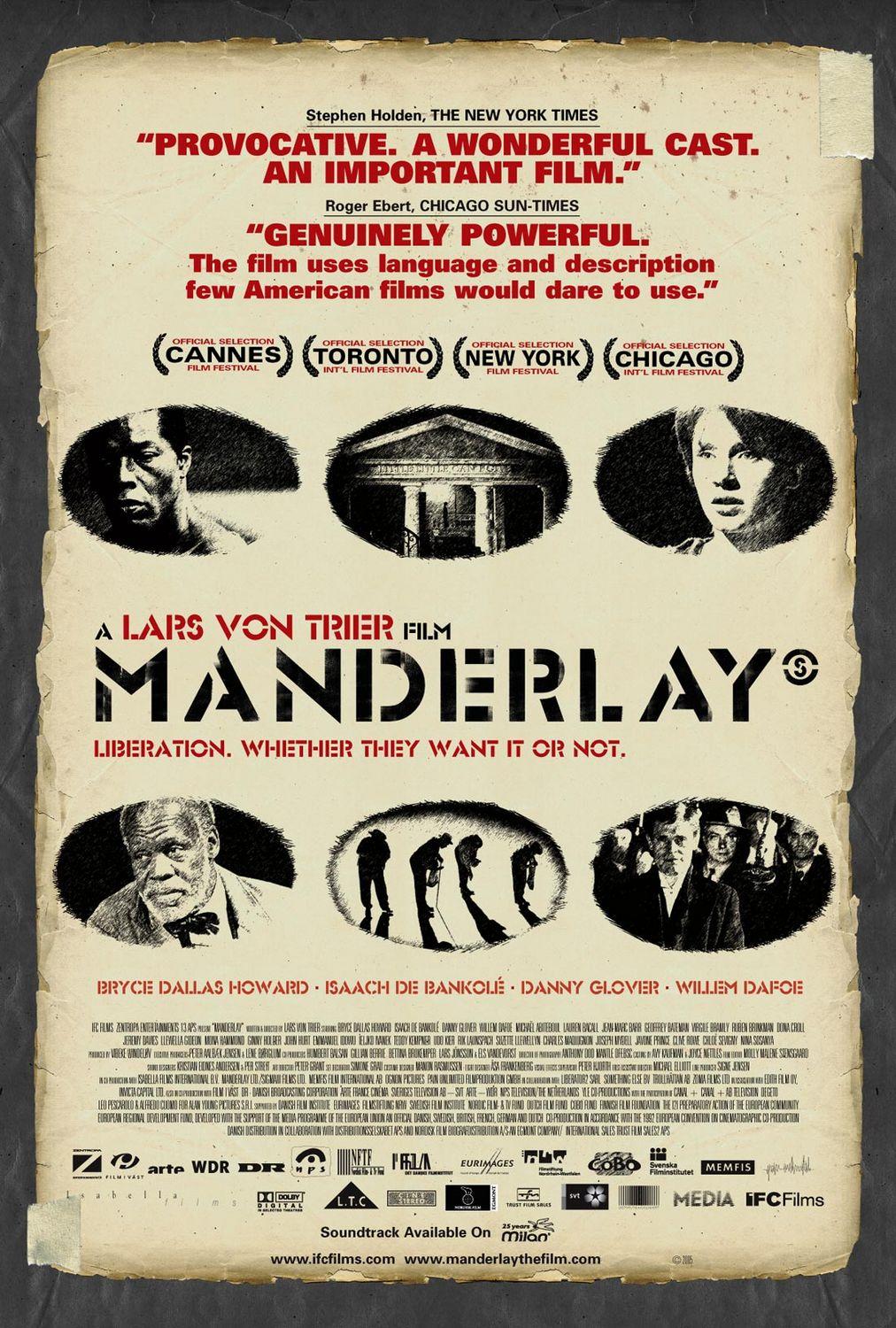
I find it interesting to note that many critics have expressed an outrage against this film because its director, a man who has never been to this country due to a fear of flying, has dared to paint a picture of America that we may not like. It's funny, because for the past 100 years of film-making, American cinema has taken liberties with criticizing other cultures and presenting racial stereotypes left and right without batting an eye (and even awarded such films either on acting or directing, etc.).
Most recently, THE LAST SAMURAI presented a portentuous and condescending Tom Cruise teaching a samurai of all people how to be... a samurai! Now we cringe and scream when a Danish director brings a movie that touches on a part of our history we'd rather not touch? It's interesting though. I went into MANDERLAY only for its Brechtian concept and nothing else. Not having seen DOGVILLE, I can't opine in terms of how does this compare to its predecessor. It did take me a little to get into the swing of the story, but once I got past the gigantic blueprint that was the mise-en-scene, even though the story kept changing tones from a straightforward epic to an erotic drama and back again and John Hurt's voice kept resembling Anthony Hopkins' in BRAM STOKER'S Dracula, I was hooked.
However, I never got the sense of history being perverted in the name of anti-Americanism in watching the events of MANDERLAY unfold. Nor did I begin comparing it to America's attempt to bring democracy to Iraq. What I did get, though, was a sense of watching a much different version of the Shirley Jackson story "The Lottery" in which a woman, in trying to do a right, gets stoned by a ritual that has no true meaning but is there because of something called the Stockholm Syndrome: where people have come to accept their situation and do nothing to change it. Grace (Bryce Dallas Howard) kept giving me data that she was like Tess Hutchinson from that short story -- idealistic, quick to act, and innocent of her surroundings. She is the younger version of Mam (Lauren Bacall), who at first seems to be the victimizer but is later revealed to be the victim. She's thrown into the battlefield of Manderlay, trained much like Patty Hearst, until one day Manderlay exposes its ugly teeth and comes out to bite her in the last ugly chapter. And this is what I believe is the theme of MANDERLAY: in trying to do a right, one person unleashes a flood of wrongs because there are people who do not want to be taught. Lars von Trier has presented in this film a sharp but exacting allegory of human nature that is not meant to be take literally but is aimed at the thinking audience.
عرض المزيد